Published July 19, 2018
How Much Does It Cost to Build a Garage? Real Estimates for Homeowners

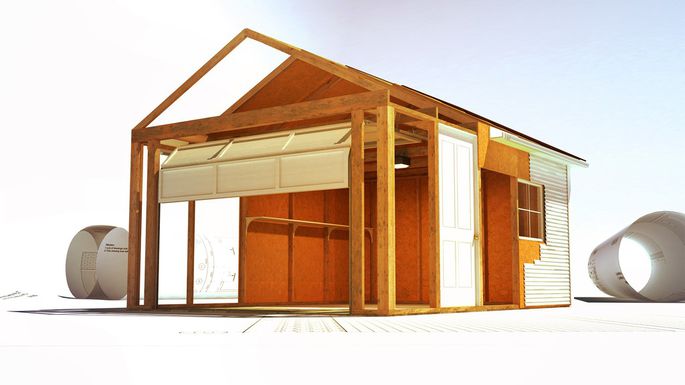

Curious about the cost of building a garage? Whether it's
attached or free-standing, a garage has many possible functions and is a good
amenity to consider adding, if you don't yet have one. It helps you
to store the junk that you can’t seem to part with, it gives
you a place to park your car, and can even house your laundry machines.
Estimating the cost of building a garage will take into
account a number of factors, including the size, the materials used, price of
permits, labor costs, and any extra bells and whistles you want to add.
Let's take a look at overall costs.
How much does it cost to build a garage?
On average, it costs around $40,000 to build a garage from
scratch, according to Jerry Banks, a project manager at Judd
Builders, a custom home builder in Asheville, NC. He projects the
timeframe for building most types of garage at two to three months.
However, exactly where and what you build will obviously
affect the price. According to HomeAdvisor, in Birmingham, AL, the average
garage addition costs $34,232. Los Angeles is slightly higher, at $35,840.
Bostonians can expect to pay around $43,316. And in Indianapolis, IN, the cost
to build a garage is very reasonable, at around $19,807.
“Any place that requires union labor is going to cost more,”
says Mike Arman, the economic development director for the City of
Oak Hill, FL. In areas like New York City—where detailed building codes,
lots of inspections, and sealed engineered drawings are required—the cost will
be much higher.
Before you build
Before any construction begins, you’ll need to check with
your municipality to identify the zoning laws for your zone district. These
laws will ultimately determine whether you can build a garage or not. Just
search for zoning information on your city's website, or call the planning,
building, or community development department.
Materials
The cost of building a garage will largely be determined by
the materials you choose. Do you want wood sheathing or metal panels for the
walls? A steel garage door or one made out of fiberglass? Keep the following
major parts of a garage in mind when planning your project.
Framing
- Number of studs and joists
- Number of subflooring sheets, wall board (i.e. drywall)
Foundation
- Amount of concrete needed for footers
- Concrete needed for a slab
- Blocks needed for a foundation
Roofing
- Number of rafters or trusses
- Number of sheets of plywood or oriented strand board
(OSB)
- Number of shingles
Garage door
- Automatic or manual
Electrical wiring
- Lighting
- HVAC
Plumbing
Cold water vs. hot water for a laundry machine
Attached or free-standing garage?
Where you decide to build your garage will also influence
the overall price.
Attached garages tend to be more cost-effective than
free-standing units, because you will only need to build three walls. Another
benefit: an attached garage will be considered part of the house, so if a tree
falls on it, it's covered by your standard home insurance plan. “If it is
not attached, it is considered an accessory building, and coverage is limited
to 10% of the amount of coverage on the main dwelling,” Arman says.
However, the masonry involved in an attached garage is more
demanding. "You'll need sledgehammers and a masonry saw (which is big,
heavy, and dangerous) to make the doorway into the house,” Arman says.
Additionally, you'll probably want to match the garage to the
existing material used for the house.
Getting permits
Once you decide what type of garage you want, you’ll need
to secure the necessary permits. While the process of getting
your project permitted can be stressful, having a permit will ensure that your
build is done according to health and safety codes. An improperly constructed
home could put you at risk of fire (from poor wiring) or structural damage.
Banks says you’ll need a Residential Construction Building
Permit that covers electrical, mechanical, and plumbing (if a water heater will
be located in the garage).
Hiring a contractor
If you choose to have a contractor build your garage, Banks offers three tips:
- Always make sure to check with your state's licensing
board to ensure the contractors have met the state's requirement for
licensure.
- Don't simply rely on online reviews. Go further and ask
friends, family, and neighbors for referralsmake sure former customers
were satisfied with the contractor's skill level, communication, and
project billing/pricing.
- Ask multiple contractors for estimates. If one is
substantially lower, there may be a (disturbing) reason why.
- Ask about the quality of materials and about which
companies they will be subcontracting.
- Be sure that the contractor verifies that all
subcontractors are licensed and insured.
- Ask how long the contractors warranty their work if
something were to go wrong after they're off the job site.
Thinking about adding a garage at your current home? Contact
the professionals on The Mary Gilbert Group for all your Real Estate needs!
541.371.5500 or sold@marygilbert.com.
By: Realtor.com,
Terri Williams

Mary Gilbert
Realtor, Team Leader | Mary Gilbert Group – Roseburg, OR Real Estate Agent
or another way